Fishing the Moon
Installation
water · light · frequency · vibration
2014
Form is emptiness, emptiness is form.
Emptiness is not separate from form, form is not separate from emptiness.
Whatever is form is emptiness, whatever is emptiness is form.
they do not appear or disappear; not tainted or pure, not increase or decrease. no form, no feelings, no perceptions, no impulses,
no beginning nor end and so forth until no realm of mind consciousness.
- The Heart Sutra
When a star collapses under its own gravity, it may become a black hole. Light does not escape it. It is known not by seeing it, but by what bends around it.
I think of this as a description of loss.
Something that was present becomes concentrated in its absence. It cannot be seen directly, yet it continues to alter the field around it.
After someone I loved disappeared from form, I began to ask whether an existence that has left its visible shape might still appear through other conditions: light, water, vibration, memory, perception.
Not return. Not remain. But appear.
Like the moon reflected in water.
There is an old story of monkeys trying to catch the moon in a well. They reach toward the reflection, believing it to be the moon itself. The moment the water is touched, the image breaks apart.
For a long time, I thought this was a story about illusion.
Later, I began to understand it differently.
The moon in the water is not simply false. It appears through precise conditions: darkness, light, surface, distance, and the eye that looks. Without these conditions, there is no reflection. Yet when they come together, the moon appears completely.
The moon in the water is not false. The moon in the sky is not ultimately real. Both arise through conditions.
Emptiness is not nothingness. It is appearance through another set of conditions.
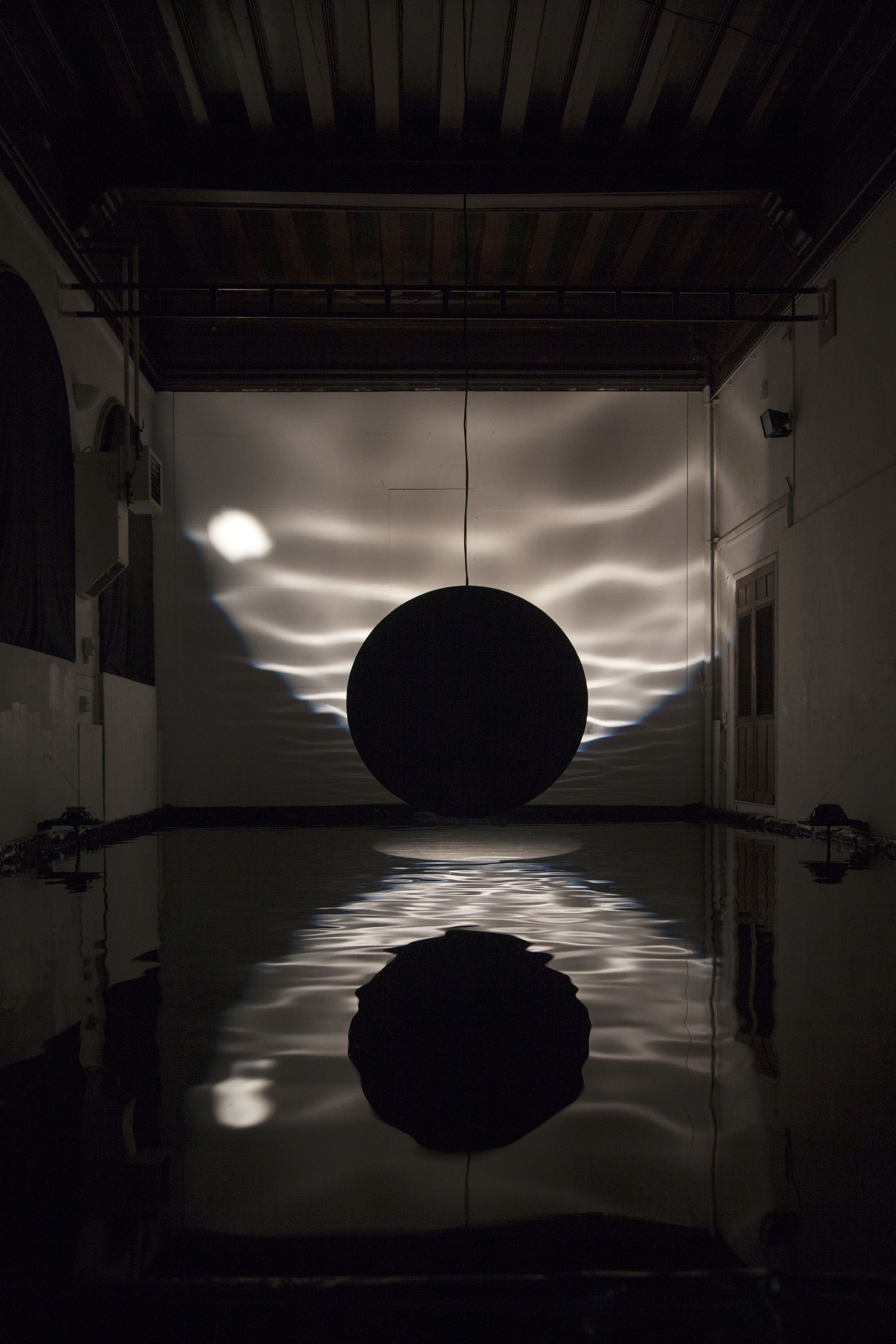
Visitors enter through a long, dark tunnel. At the end of the passage, the space opens into a room of water, light, and vibration. The interior seems larger than the exterior, as if one had entered not a room, but an inward dimension.
The lighting is arranged so that its source cannot be easily located. One cannot tell whether light is reflected from the water onto the walls, or from the walls back onto the water. Reflection loses its direction. Space begins to loosen its edges.
The room is sustained by a low-frequency vibration of 7.83 Hz — the fundamental frequency often associated with the Schumann resonance, the electromagnetic resonance between the Earth's surface and its ionosphere. This frequency also falls near the range of slow brain rhythms associated with meditative states.
I was interested less in proving a correspondence than in creating a condition of resonance.
When a visitor enters the space, the body disturbs the water. Disorder enters. The surface breaks, trembles, and reorganizes. The irregular waves meet the underlying vibration of the room. Through light, this process is projected onto the walls, the ceiling, the water, and the body of the viewer.
Disorder becomes resonance. Resonance becomes a temporary order.
One is not simply looking at water. One is looking at perception taking form.
I think of this as a description of loss.
Something that was present becomes concentrated in its absence. It cannot be seen directly, yet it continues to alter the field around it.
After someone I loved disappeared from form, I began to ask whether an existence that has left its visible shape might still appear through other conditions: light, water, vibration, memory, perception.
Not return. Not remain. But appear.
Like the moon reflected in water.
There is an old story of monkeys trying to catch the moon in a well. They reach toward the reflection, believing it to be the moon itself. The moment the water is touched, the image breaks apart.
For a long time, I thought this was a story about illusion.
Later, I began to understand it differently.
The moon in the water is not simply false. It appears through precise conditions: darkness, light, surface, distance, and the eye that looks. Without these conditions, there is no reflection. Yet when they come together, the moon appears completely.
The moon in the water is not false. The moon in the sky is not ultimately real. Both arise through conditions.
Emptiness is not nothingness. It is appearance through another set of conditions.
Visitors enter through a long, dark tunnel. At the end of the passage, the space opens into a room of water, light, and vibration. The interior seems larger than the exterior, as if one had entered not a room, but an inward dimension.
The lighting is arranged so that its source cannot be easily located. One cannot tell whether light is reflected from the water onto the walls, or from the walls back onto the water. Reflection loses its direction. Space begins to loosen its edges.
The room is sustained by a low-frequency vibration of 7.83 Hz — the fundamental frequency often associated with the Schumann resonance, the electromagnetic resonance between the Earth's surface and its ionosphere. This frequency also falls near the range of slow brain rhythms associated with meditative states.
I was interested less in proving a correspondence than in creating a condition of resonance.
When a visitor enters the space, the body disturbs the water. Disorder enters. The surface breaks, trembles, and reorganizes. The irregular waves meet the underlying vibration of the room. Through light, this process is projected onto the walls, the ceiling, the water, and the body of the viewer.
Disorder becomes resonance. Resonance becomes a temporary order.
One is not simply looking at water. One is looking at perception taking form.

Fishing the Moon. Installation view, Taikang Space,
At the centre of the installation hangs a black moon. Its surface absorbs almost all visible light. Depending on where one stands, it may appear as a sphere, a thin plane, an opening, or a black hole.
It does not reveal itself. It holds the question open.
Below it, another moon appears in the water. One above, one below. One suspended, one reflected. Neither can be possessed. Neither has fixed nature.
Water becomes cloud, rain, snow, vapor, tear, wave. It does not pass from being into non-being. It changes condition.
What we call disappearance may also be a change of condition.
The work does not bring back what has disappeared. It does not offer consolation in the form of belief. It offers something smaller, and perhaps more precise: a moment in which the desire to grasp becomes visible.
The reaching hand hovers above the water. The reflection trembles. The moon cannot be caught.
But something is understood.
What is fished up, in the end, is not the moon. It is a small awareness of the conditions that made the moon appear at all.
诸法空相
All phenomena are empty of fixed nature.
This is not loss.
This is how everything moves.
It does not reveal itself. It holds the question open.
Below it, another moon appears in the water. One above, one below. One suspended, one reflected. Neither can be possessed. Neither has fixed nature.
Water becomes cloud, rain, snow, vapor, tear, wave. It does not pass from being into non-being. It changes condition.
What we call disappearance may also be a change of condition.
The work does not bring back what has disappeared. It does not offer consolation in the form of belief. It offers something smaller, and perhaps more precise: a moment in which the desire to grasp becomes visible.
The reaching hand hovers above the water. The reflection trembles. The moon cannot be caught.
But something is understood.
What is fished up, in the end, is not the moon. It is a small awareness of the conditions that made the moon appear at all.
诸法空相
All phenomena are empty of fixed nature.
This is not loss.
This is how everything moves.


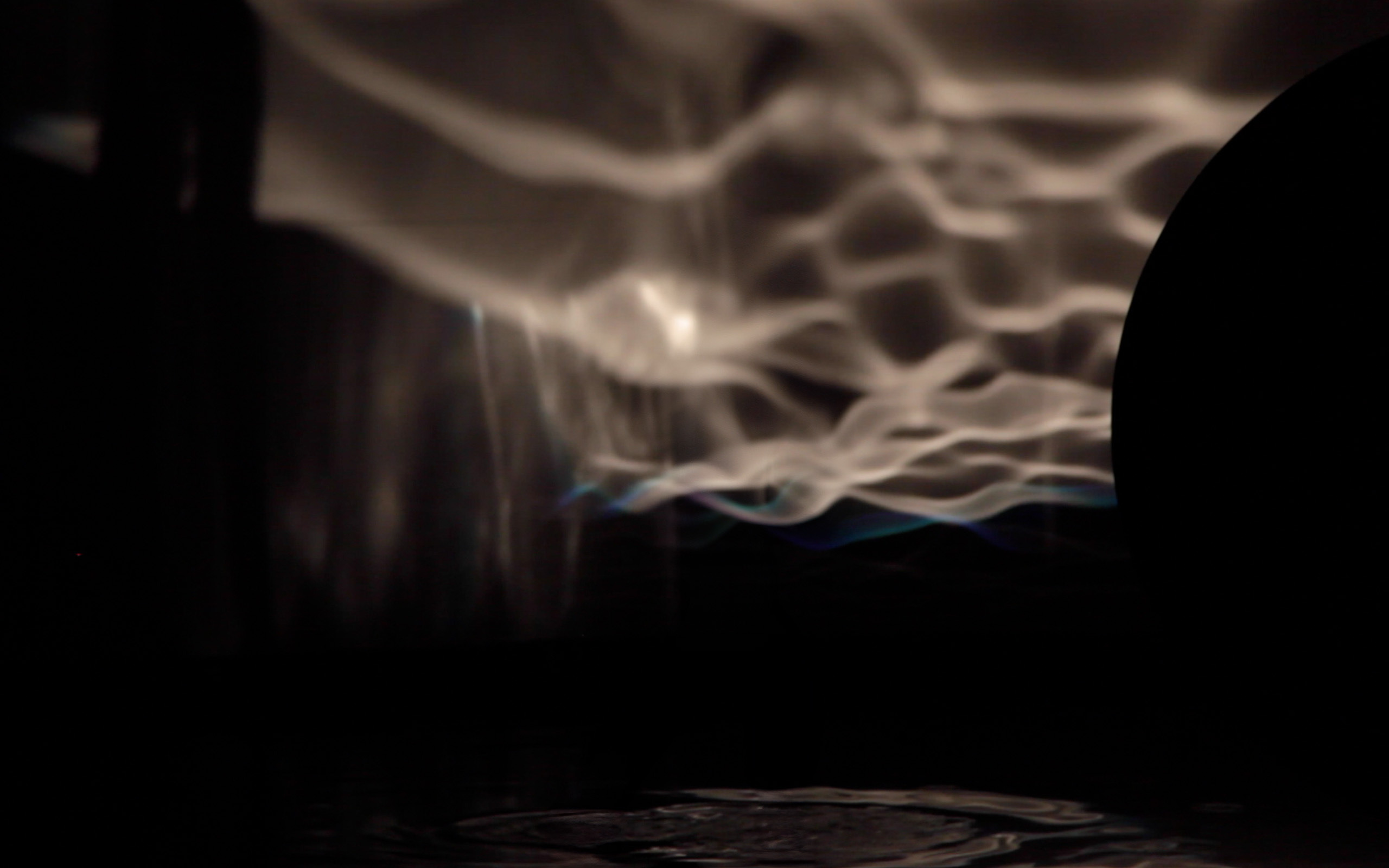
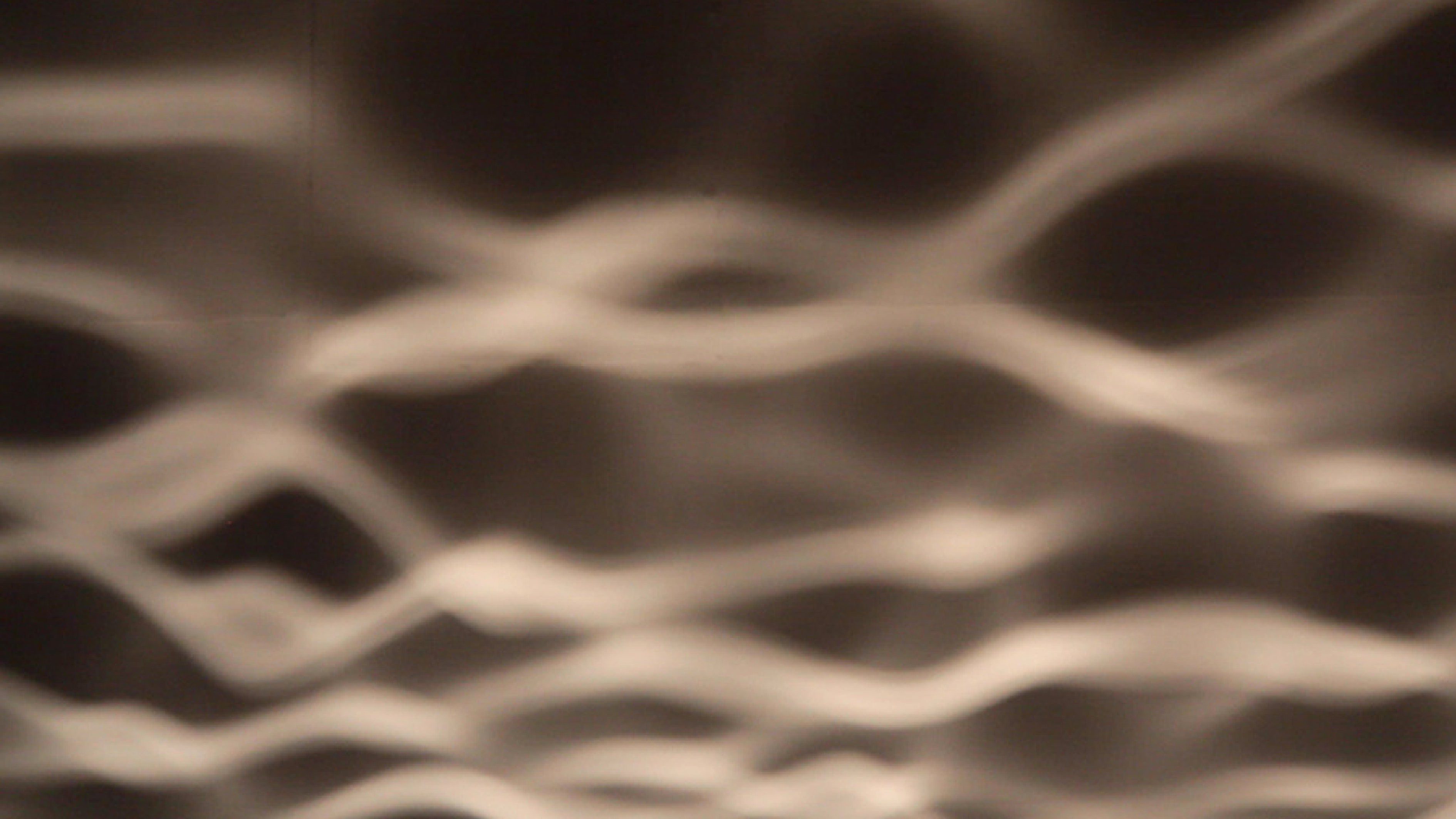


Fishing the Moon, 2014. Installation view, École nationale supérieure des Beaux-Arts, Paris.
Technical note
Water, reflected light, low-frequency vibration, suspended black moon.
The room is tuned to 7.83 Hz — the fundamental frequency of the Schumann resonance. The suspended black moon absorbs 99.6% of visible light. Visitor movement disturbs the water and changes the reflected light field.
Water, reflected light, low-frequency vibration, suspended black moon.
The room is tuned to 7.83 Hz — the fundamental frequency of the Schumann resonance. The suspended black moon absorbs 99.6% of visible light. Visitor movement disturbs the water and changes the reflected light field.