The Collective Seabed
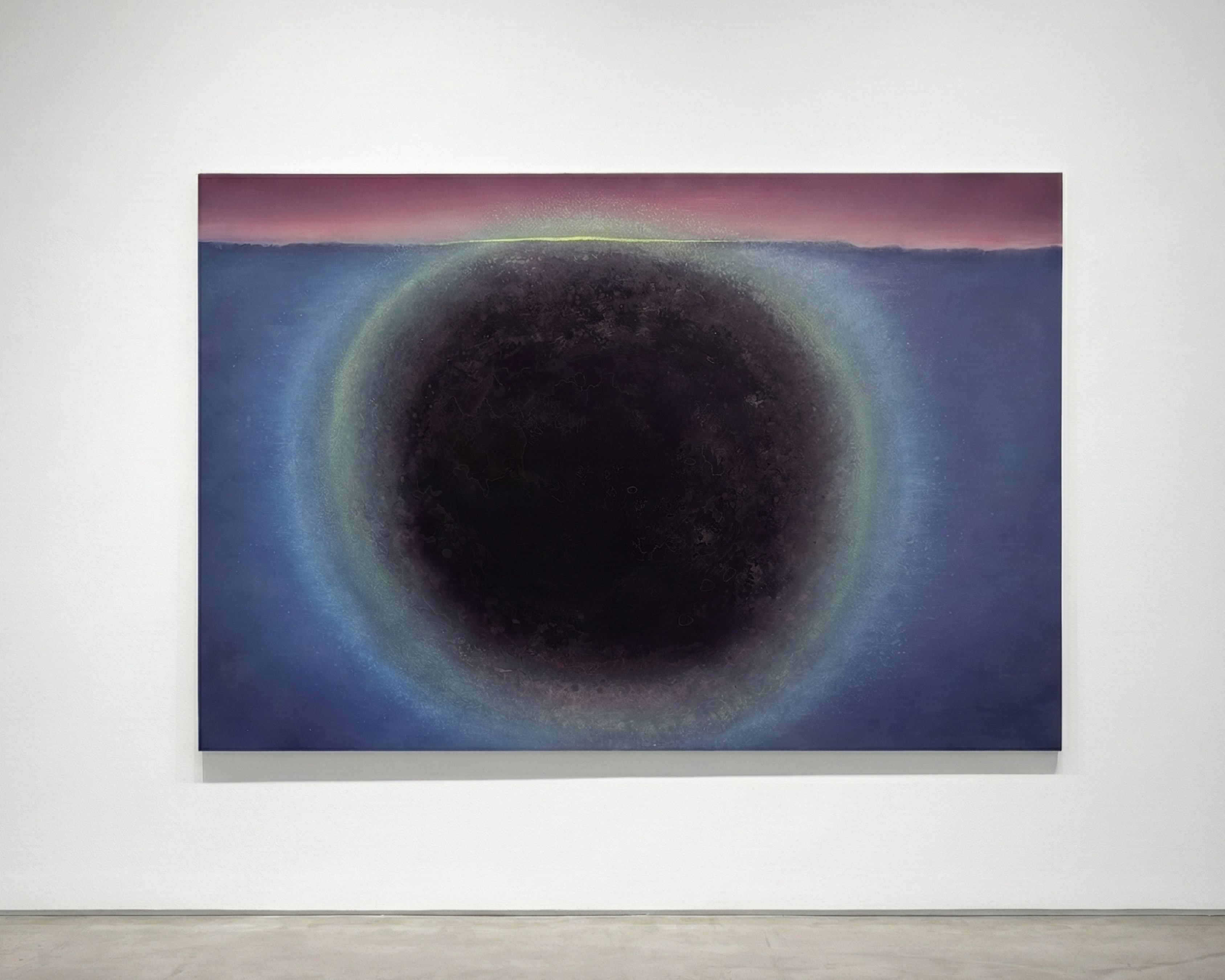
The Form Consciousness Takes When It Recognizes Itself
The primordial form of consciousness emerges here.
Fluid consciousness begins to flow.
Emptiness, light, boundlessness, and permeation within the image
coalesce into a field without orientation.
Up and down, front and back, depth and distance are weakened;
the sense of time begins to loosen.
This is not the depiction of an object,
but the presentation of a process—
how awareness generates the world.
At the upper edge, a surface resembling a horizon
appears as a boundary of consciousness;
at the center, an intensely dark void core;
around it, layers of particulate halos and blue mist unfold,
as if the field of consciousness were breathing.
The upper edge is not a landscape,
but a threshold of awareness.
Space expands here, boundaries soften;
viewing no longer points toward an object,
but opens into a larger field.
The central black is not an object,
but a void that absorbs narrative.
It does not symbolize, it does not explain;
it resists understanding.
Here, interpretation recedes,
and pure perception emerges.
Consciousness seems to withdraw its center,
leaving an experience without center, without grasping.
The outer halo resembles the boundary of a torus field;
the breathing of consciousness generates ripples here.
The blue mist becomes a medium of perception—
neither sea nor sky,
but a state of awareness in which one may sink or float.
Light does not illuminate the center,
but forms a halo at the boundary between center and periphery.
Consciousness does not occupy the core,
but appears at the boundary between the visible and the unseeable.
The world is not external.
The world is a presentation of awareness.
Thus, the black in this image is no longer nothingness,
but a horizontally extended chamber of energy,
holding breath and release—
the silence of the source.
At the center of darkness,
tiny particles of light slowly descend,
like unnamed thoughts
returning to the source in silence.
The halo is no longer an effect,
but the self-refraction of awareness at the boundary.
The upper edge is no longer a horizon,
but the division between consciousness and narrative.
Crossing and remaining
coexist here.
The position where the observer stays
no longer requires alignment with a single threshold of viewing.
Viewing itself is occurring,
yet there is no fixed “I” who is viewing.
As viewing loosens from its former position,
the sense of time, habitual responses, and self-narrative begin to soften.
The image is only a field.
The real transformation
takes place between viewing and viewing.
That layer which belongs neither to the world
nor to the self
is the trace left when consciousness observes itself.
Not to explain,
but to reveal.
Not a form,
but an entrance.
Here, boundaries loosen:
water and night, outer and inner, seeing and not-seeing.
No objects remain,
only an inward flow.
Between the faint light of thresholds,
everything takes form in silence.
Oil on canvas